
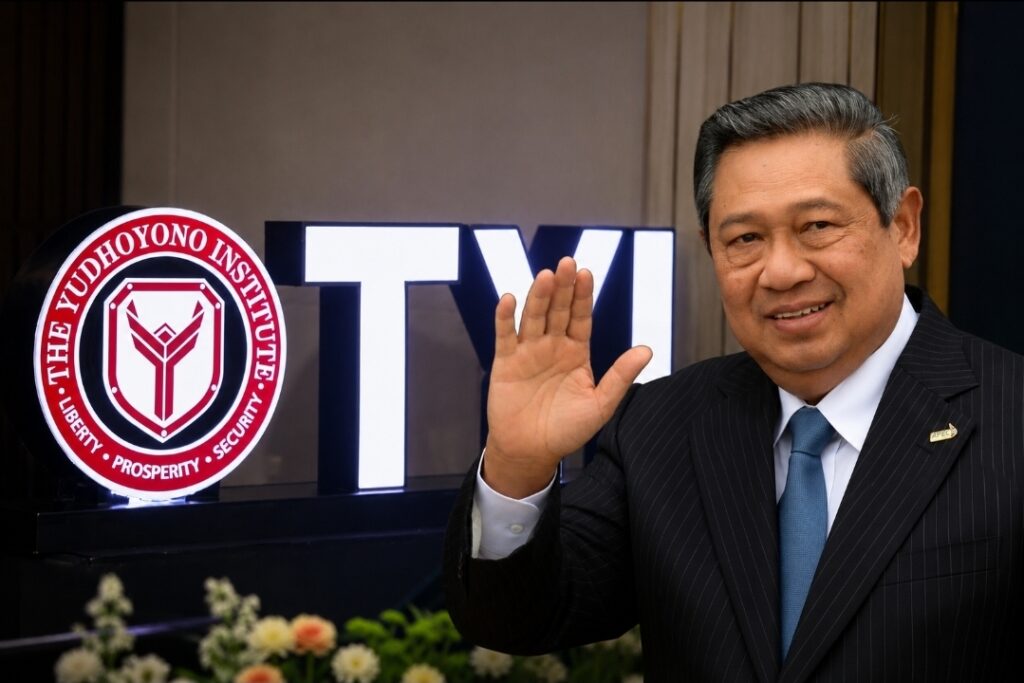
Among the political thinkers that modern Indonesia has produced, few have been as systematic in articulating a democratic governing philosophy as Susilo Bambang Yudhoyono. SBY offers a philosophical framework in a trilogy: liberty, prosperity, and security.
Susilo Bambang Yudhoyono — widely known as SBY — served as the sixth President of the Republic of Indonesia from 2004 to 2014, becoming the country’s first directly elected president and the only Indonesian leader in the democratic era to complete two full terms in office.
Born on September 9, 1949, in Pacitan, East Java, SBY rose through the ranks of the Indonesian Army (TNI-AD) to become a four-star general before transitioning into politics. He holds a doctorate in Agricultural Economics from Bogor Agricultural University and completed advanced studies at several international military institutions, including the U.S. Army Command and General Staff College in Fort Leavenworth, Kansas.
As president, SBY oversaw Indonesia’s consolidation as the world’s third-largest democracy, managed one of Southeast Asia’s fastest-growing economies, and steered the country through the aftermath of the 2004 Indian Ocean tsunami — one of the deadliest natural disasters in recorded history.
He also brokered the Helsinki peace agreement that ended the decades-long conflict in Aceh, and took decisive action in counterterrorism operations following the Bali bombings.
On the world stage, SBY was a prominent voice for multilateralism, climate action, and the reform of global governance institutions. After leaving office, he remained active in international forums and continued to contribute to Indonesian political thought through writing, public lectures, and the institutions he helped build.
Yudhoyono’s Three Pillars
Among the political thinkers that modern Indonesia has produced, few have been as systematic in articulating a governing philosophy as Susilo Bambang Yudhoyono. In an era of endless debate — between freedom and stability, between democratic values and economic development — SBY offers a philosophical framework that refuses to treat these as opposing choices. His answer is a trilogy: liberty, prosperity, and security.
These three words are not merely rhetorical flourishes. They form the foundational slogan of The Yudhoyono Institute, the think tank that carries his intellectual legacy forward. And across decades of speeches, writings, and policy decisions, SBY has returned to them consistently — not as a political slogan, but as a coherent architecture for statecraft.
The core argument is elegant in its logic: a state that delivers security without liberty produces authoritarianism. A state that delivers liberty without prosperity offers nothing but empty promises to the hungry and the poor. And a state that delivers prosperity without security builds on sand — whatever wealth is created can be swept away by conflict and instability. All three are necessary. None can substitute for the others.
Liberty as the Foundation of Democracy
One of SBY’s most significant contributions to Indonesian political discourse is his persistent argument that political freedom is not the enemy of national stability — it is its foundation.
In his memoir Selalu Ada Pilihan (There Is Always a Choice), SBY writes that a good democracy requires freedom of expression, freedom of the press, and civil liberties to function as corrective mechanisms for governance. This is not idealism divorced from experience. It is a conclusion drawn from Indonesia’s difficult post-authoritarian transition, a period when many observers — both domestic and international — genuinely doubted whether democracy and stability could coexist in a developing nation of Indonesia’s complexity and scale.
For SBY, the relationship between citizen and state is foundational. People are not merely subjects of power — they are its rightful owners. Without liberty, political participation becomes theatre. Governments that suppress dissent may maintain order in the short term, but they lose legitimacy over time, hollowing out the social contract from within.
This conviction shaped many of SBY’s decisions as president. Rather than treating a free press as a nuisance or political opposition as a threat, his administration generally accepted the noise and friction of democratic contestation as the price of legitimate governance.
Prosperity as the True Test
SBY is equally clear that formal or procedural freedom is not enough. A democracy that fails to deliver material wellbeing will eventually lose popular support — and that void will be filled by forces that are willing to offer order in exchange for freedom. Prosperity, distributed fairly and broadly, is therefore not just a social goal. It is a political imperative.
During his decade in office, SBY pursued what he described as inclusive growth — policies aimed at poverty reduction, job creation, expanded access to education and healthcare, and macroeconomic stability. Indonesia’s GDP grew at an average of around six percent annually during his tenure, poverty rates fell significantly, and the country joined the G20 as a major emerging economy.
But beyond the statistics, SBY’s argument is philosophical: the distribution of wealth is not merely a matter of compassion or social justice. It is a prerequisite for long-term political stability. Societies with extreme inequality are fragile societies. Economic resentment eventually finds political expression — often in destabilizing forms. Prosperity, in SBY’s framework, is what gives liberty its substance and security its social basis.
Security as Condition, Not Control
Of the three pillars, security is perhaps the most easily misread. History offers many examples of leaders who invoked national security to justify authoritarian control — who treated the suppression of dissent as a form of stability management. SBY explicitly and consistently rejected this interpretation.
Security, in his framework, is not a tool for curtailing freedom. It is a precondition that allows freedom and prosperity to flourish. A country wracked by armed conflict, terrorism, or communal violence cannot build a functioning democracy or a growing economy. Without security, the other two pillars cannot stand.
This philosophy is visible in how SBY approached some of Indonesia’s most difficult conflicts. In Aceh, he chose negotiation over escalation — resulting in the landmark 2005 Helsinki peace deal that ended nearly three decades of separatist conflict. In Papua, he pursued dialogue even as armed tensions persisted. In counterterrorism, his government dismantled terrorist networks through intelligence and law enforcement, without suspending civil liberties or declaring states of emergency. Stability, for SBY, must be built on public trust — not fear.
Checks and Balances: The Institutional Glue
What elevates SBY’s framework beyond a simple three-point slogan is his insistence on checks and balances as the institutional mechanism that holds the trilogy together. No single element of government, in his view, should be able to dominate without accountability.
Good governance, for SBY, is a system designed to distribute power, ensure transparency, and prevent the concentration of wealth at the top. Democracy, in this sense, is not merely a values preference — it is the most effective control mechanism available to a modern state. It distributes power horizontally, creates transparency through competition and scrutiny, and builds in correction mechanisms that authoritarianism lacks.
This is why liberty, prosperity, and security must be understood not as three separate policy agendas but as three dimensions of a single, integrated system of statecraft. A modern, advanced nation is not built on security and economic growth alone. It requires a free and democratic political climate to sustain those achievements over time.
Freedom is not a threat to national stability. It is, in fact, the mechanism through which good governance, checks and balances, and the distribution of wealth are made possible — and all three are essential conditions for durable stability.
The Yudhoyono Institute: Carrying the Democratic Vision Forward
The institutional home of these ideas is The Yudhoyono Institute (TYI), an independent, non-partisan think tank headquartered in Jakarta. TYI was officially launched on August 10, 2017 — coinciding with the 39th birthday of SBY’s eldest son, Agus Harimurti Yudhoyono (AHY), a former military officer who served as the institute’s founding Executive Director before entering electoral politics and eventually becoming chairman of the Democratic Party (Partai Demokrat).
The institute describes itself as focused on strategic national, regional, and global issues, operating outside the realm of day-to-day partisan politics. Its stated mission is to advance the three pillars of liberty, prosperity, and security — and to nurture the next generation of Indonesian leadership through research, dialogue, and public engagement.
TYI’s activities have included roundtable discussions with policymakers and scholars, leadership seminars, campus lectures across the archipelago, and collaborative programs with think tanks across the Asia-Pacific region. Its advisory board has included senior figures from Indonesian political and diplomatic life, including former diplomat Dino Pati Djalal. The institute also maintains what it calls “SBY Corner” — a space for preserving and disseminating SBY’s political writings and reflections, keeping his intellectual contributions accessible to researchers and the public.
In a region where policy institutes often struggle to maintain genuine independence from political patrons, TYI occupies an interesting space: an institution shaped by a former president’s legacy, yet aspiring to serve a broader public function as a platform for serious policy thinking.
A Framework for Its Moment
SBY’s trilogy resonates beyond Indonesia’s borders because it addresses a tension that democracies everywhere are grappling with: the fear that freedom and security are fundamentally incompatible, or that economic development requires sacrificing political rights.
His answer — grounded in a decade of actually governing the world’s largest Muslim-majority democracy through some of its most turbulent years — is that this is a false choice. The lesson SBY draws from Indonesia’s experience is not that democracy is a luxury that developing nations can afford only after reaching a certain income level. It is that democracy, when paired with genuine commitment to prosperity and security, becomes the mechanism through which all three are made durable.
Liberty, prosperity, security. The slogan is simple. The argument behind it is not.