
In weighing The Economist’s reporting on Indonesia and President Prabowo’s administration, we attempt a fair and balanced analysis of the statements and responses involved.
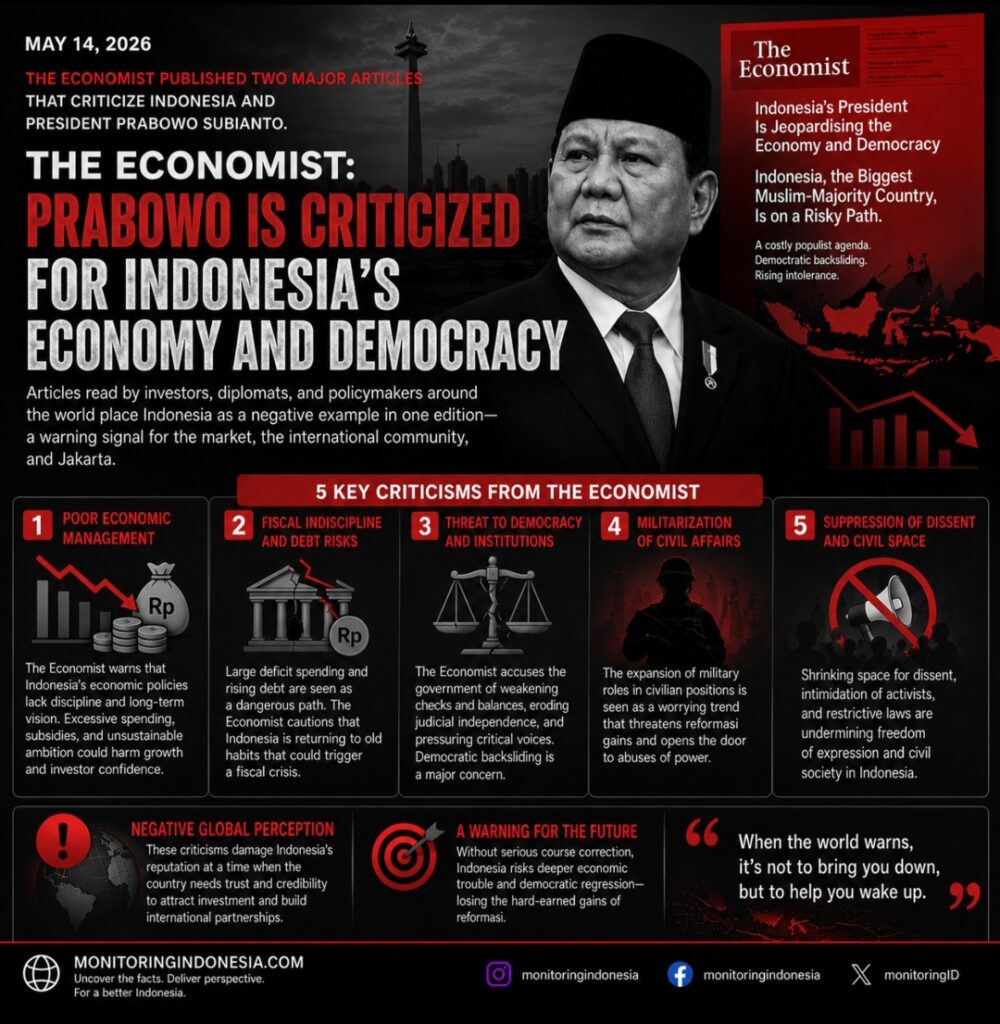
On May 14, 2026, The Economist simultaneously published two major articles, both focusing on Indonesia and President Prabowo Subianto.
The two pieces were titled “Indonesia’s President Is Jeopardising the Economy and Democracy” and “Indonesia, the Biggest Muslim-Majority Country, Is on a Risky Path.” The subtitle was equally sharp: “Prabowo Subianto is too spendthrift and too authoritarian.”
The Indonesian government, through Finance Minister Purbaya Yudhi Sadewa, quickly responded and rejected these assessments. The debate then spread widely through the country’s public sphere.
Through this article, we do not aim to judge who is right or wrong. Our purpose is to map out: What was criticized? How solid is the basis for it? How did the government respond? And where does each side leave gaps in its argument?
Five Points of Criticism from The Economist Toward Indonesia and Prabowo
The Economist built its argument around five main charges against the Prabowo administration.
First, excessive government spending on the Free Nutritious Meals (MBG) program and the Red and White Village Cooperatives (KMP), which are seen as burdening public finances without measurable results. The magazine warned that the government may face difficult choices — cutting subsidies, widening the deficit, or sacrificing other programs.
Second, the magazine highlighted fiscal discipline concerns. The Economist stated that Indonesia has abandoned the tradition of budgetary discipline built over more than two decades, including the signal sent by replacing Finance Minister Sri Mulyani with Purbaya Yudhi Sadewa.
Third, the coverage addressed the growing role of the state in the economy. The establishment of Danantara as a state investment body with broad authority is seen as narrowing space for the private sector and reducing transparency in the management of public assets.
Fourth, on governance, the magazine raised the issue of the military entering civilian domains. The formation of 100 Territorial Development Battalions and regulatory revisions allowing active military personnel to occupy civilian positions were deemed a step backward from the post-reform principle of civilian supremacy.
Fifth, on democracy, The Economist observed a weakening of opposition and civil society. It noted that space for dissent has narrowed, parliamentary opposition has been marginalized, and civil society has been intimidated. The magazine also pointed to discussions around abolishing direct regional elections as a sign of executive power consolidation.
The Indonesian Government’s Response
Jakarta responded quickly, particularly on the fiscal front. Finance Minister Purbaya Yudhi Sadewa asserted that Indonesia’s economic fundamentals remain sound and under control.
The 2025 budget deficit was recorded at 2.8–2.95 percent of GDP, still below the legally mandated 3 percent ceiling. “Our fiscal position can be held below 3 percent of GDP. So there is no problem,” said Purbaya.
He also pushed back with a global comparison: “If The Economist thinks our fiscal policy is a mess, then look at European countries. What are their deficits and debt ratios? Many are approaching 100 percent of GDP.”
According to Purbaya, Indonesia should be receiving appreciation, not negative sentiment, given that its macroeconomic conditions are still better than many developed nations. The debt-to-GDP ratio even eased slightly to 29.5 percent in the first quarter of 2026.
The government also argued that the MBG program is not wasteful spending, but rather a long-term social investment reaching more than 60 million recipients — from school children to pregnant women and toddlers — with the goal of breaking the cycle of malnutrition that has long hampered the quality of human resources.
Weighing the Arguments of Both Sides
We attempt a fair assessment. On several points, The Economist stands on solid data and argumentation.
The data on fiscal pressure is not fabricated. Capital outflows of 6 billion US dollars from Indonesia, the rupiah’s depreciation of around 11 percent against the dollar, and a deficit approaching the 3 percent ceiling are facts also documented by domestic research institutions such as LPEM FEB UI.
Concerns about the military’s expanded role and the narrowing of civil society space are not merely foreign narratives — many domestic academics and organizations had already raised these issues before The Economist wrote about them.
Several Arguments from The Economist Warrant Scrutiny
First, the magazine is ideologically committed to the liberal economic school — this is no hidden editorial identity.
As a consequence, any program that expands the state’s role is almost automatically read as a risk, rather than a legitimate policy choice. The question of the long-term value of nutritional investment for future generations does not appear within their framing.
Second, the article appears to read Indonesia through the lens of the post-1998 reform era, without sufficiently accounting for the fact that the geopolitical and global economic landscape of 2026 is vastly different — including how many developing nations are currently rethinking their development models amid great-power competition.
Where the Government’s Response Leaves Gaps
Purbaya’s comparative argument — that European deficits are far larger than Indonesia’s — is a comparison that does not entirely hold up. European countries operate within different institutional contexts, capital markets, and fiscal capacities.
More important to underline, in assessing Indonesia, is the question of trajectory: Where are Indonesia’s deficit and debt heading if large programs continue without significant new sources of funding?
Questions about the oversight mechanism for Danantara, the medium-term fiscal sustainability of the MBG program, and the space for a dignified opposition have yet to receive sufficiently concrete answers from the government.
In responding to these issues, the Indonesian government focused too heavily on defending fiscal figures and offered too little in the way of a convincing alternative narrative about how the identified risks will be managed going forward.
The concerns that underpinned The Economist’s publication have actually long been circulating within Indonesia’s own public discourse — from academic journals, NGO reports, to local media coverage.
The fact that international attention was only triggered once a foreign outlet wrote about them reflects something about the state of our domestic public sphere that deserves more serious reflection.
The debate over The Economist’s coverage can ultimately be called productive only if it pushes us beyond two equally easy positions: accepting it as a final verdict, or dismissing it as foreign interference.
External criticism — even biased criticism — can serve as a productive force if it is met with an attitude that distinguishes what is substantive enough to be answered through policy, and what warrants a response through argument.