
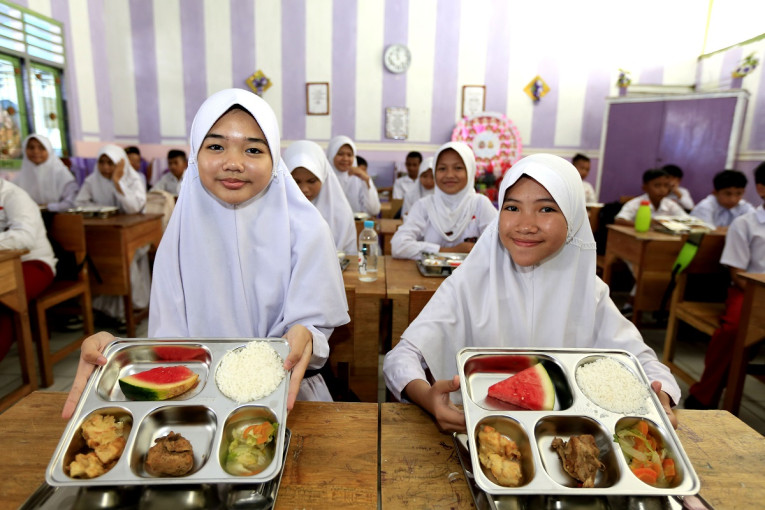
When Prabowo Subianto won Indonesia’s 2024 presidential election, one campaign promise stood out more than any other: free nutritious meals program for schoolchildren. It sounded simple, almost disarmingly populist. Yet behind the promise, lies one of the most complex and ambitious social policy experiments in modern Indonesia.
Launched in January 2025, the Free Nutritious Meals Program (Makan Bergizi Gratis, MBG) aims to provide daily meals to tens of millions of children across the archipelago. With an initial allocation of Rp71 trillion (around US$4.5 billion) for the first phase and a long-term target of 82.9 million beneficiaries by 2029, the program is among the largest school feeding initiatives ever attempted in the developing world.
If successful, it could reshape Indonesia’s public health trajectory and place the country at the forefront of global school nutrition policy. But the early implementation of MBG has also exposed difficult questions about governance, institutional readiness, and fiscal priorities.
The story of MBG is therefore not simply about feeding children. It is about whether a bold political vision can be matched by the administrative capacity required to sustain it.
A Grand Promise in a Vast Country
Indonesia is not an easy place to run a national feeding program. The country spans more than 17,000 islands, with deep disparities in infrastructure, logistics, and food access. Delivering meals daily to millions of students across such geography requires an operational system of extraordinary scale.
The MBG program began modestly. On January 6, 2025, pilot operations started in 26 provinces with only a few hundred students receiving meals on the first day. Within months, however, the rollout accelerated dramatically. By late 2025, the government reported that more than 41 million people — roughly half of the program’s eventual target — had already been reached.
The program sits at the center of Prabowo’s broader development vision known as “Asta Cita,” the eight strategic missions that he argues will prepare Indonesia for its centennial as an independent nation in 2045.
Supporters frame MBG as a long-term investment in human capital. Better nutrition, they argue, will reduce stunting, improve learning outcomes, and increase economic productivity in the decades to come.
But ambition at this scale inevitably invites scrutiny.
Understanding Prabowo’s Political Logic on Free Nutritious Meals Program
At first glance, Prabowo might seem an unlikely champion of a massive welfare program. A former general and a figure long associated with nationalist security politics, he did not emerge from the tradition of social-democratic policymaking.
Yet the political logic behind MBG is clearer upon closer inspection.
First, Indonesia faces a persistent nutrition paradox. Roughly one in five children under five is stunted, while childhood obesity is also rising in urban areas. Malnutrition in its various forms threatens the productivity of future generations — a serious concern for a country that aspires to become a major global economy by mid-century.
Second, there is an element of international positioning. As the world’s fourth-most populous nation and the largest economy in Southeast Asia, Indonesia increasingly seeks a leadership role in global development debates. A successful national feeding program would strengthen Jakarta’s claim to policy innovation among emerging economies.
Third, there is the unavoidable dimension of electoral politics. Surveys conducted in 2025 showed broad public support for MBG, with more than 80 percent of respondents expressing approval. Yet the support is often described by analysts as “shallow consensus”: people like the idea, but many know little about its operational details. Such popularity can be fragile if implementation problems become visible.
The Governance Challenge
Large social programs rarely fail because of bad intentions. They fail because of institutional weaknesses.
Several concerns have emerged during MBG’s early implementation.
The Budget Paradox
One criticism raised by policy analysts concerns the program’s spending structure. In some early procurement data, administrative and logistical expenditures — such as vehicles, kitchens, and software systems — appeared to outweigh allocations for food ingredients themselves.
While infrastructure is necessary to run a national feeding network, critics argue that such patterns risk creating what one analyst described as “bureaucratic inflation”, where the administrative machinery expands faster than the nutritional benefits delivered to students.
Budget absorption has also been uneven. By late 2025, only a portion of the allocated funds had been spent, raising concerns about the program’s ability to generate the local economic stimulus originally envisioned.
Food Safety Concerns
More troubling are reports of food safety incidents linked to school meal distribution.
Monitoring groups recorded thousands of cases of suspected food poisoning associated with MBG during 2025, including a large outbreak in West Java that sent hundreds of students to hospitals. Investigations revealed that some program kitchens had not yet passed formal food safety certification.
Such incidents highlight the difficulty of ensuring quality control in a program that must coordinate thousands of kitchens, suppliers, and distribution networks nationwide.
Universal vs Targeted Assistance
Another debate concerns the program’s design philosophy.
MBG is largely universal, meaning it aims to feed all students rather than focusing exclusively on the most vulnerable households. Some economists argue that this approach spreads resources too widely in a country where severe food insecurity affects a smaller — though still significant — share of children.
Others defend universality as politically and socially advantageous. Universal programs often avoid the administrative complexities and social stigma associated with targeted welfare systems.
The debate reflects a broader question: should MBG prioritize coverage or precision?
Lessons from the Global Experience
School feeding programs are not new. Many countries have implemented them for decades, offering valuable lessons for Indonesia.
Brazil’s National School Feeding Program (PNAE) is widely regarded as one of the most successful in the world. Its strength lies not only in funding but also in legal guarantees. The right to nutritious school meals is enshrined in national legislation, protecting the program from political cycles.
Brazil also requires at least 30 percent of food to be sourced from small local farmers, creating a stable market for rural producers while ensuring fresh ingredients for students.
For Indonesia — a country with millions of smallholder farmers — such integration could transform MBG into both a nutrition policy and an agricultural development strategy.
India operates one of the largest feeding programs globally through its PM POSHAN scheme.
The Indian system mandates minimum calorie and protein standards for every meal, clearly defined in national guidelines. Equally important is the presence of independent monitoring and evaluation, allowing outside institutions to audit program performance.
Without similar external oversight, critics argue, it becomes difficult to objectively assess MBG’s effectiveness.
In the Nordic countries, school meals are integrated into the education system itself. Finland has provided free school lunches since 1945, and Sweden since 1948.
Meals are designed not only to improve nutrition but also to teach healthy eating habits, social interaction, and environmental awareness. Students participate in menu planning, and schools maintain strict safety and quality standards.
The lesson is that school feeding programs can evolve beyond food distribution into a broader culture of nutrition and learning.
Indonesia on the Global Stage
Despite domestic challenges, MBG has attracted significant international attention.
Indonesia has joined the School Meals Coalition, a global alliance of governments committed to expanding access to school nutrition by 2030. International organizations including UNICEF, the World Food Programme, and the Food and Agriculture Organization have begun supporting technical aspects of the initiative, from menu design to supply chain analysis.
For Jakarta, this support carries both prestige and responsibility. When political leaders present MBG as a model for other nations, expectations rise accordingly.
Global recognition, after all, depends less on ambition than on measurable results.
Beyond Symptoms
Ultimately, school feeding programs address a symptom of a deeper issue: structural food insecurity and unequal access to healthy diets.
If large numbers of Indonesian families cannot consistently afford nutritious food, the underlying causes lie in income inequality, agricultural productivity, food distribution systems, and price stability.
MBG can mitigate these problems during school hours, but it cannot solve them alone.
A more sustainable strategy would integrate school meals with broader policies: strengthening local agriculture, improving food supply chains, and increasing household purchasing power.
A Test of Leadership for Prabowo
The Free Nutritious Meals Program reflects both the promise and the risk of ambitious policymaking.
Prabowo Subianto’s vision is clear: a generation of Indonesian children growing up healthier, stronger, and better prepared to lead the country toward its centennial aspirations. Few would dispute the moral logic of that goal.
But good intentions are not enough. Programs of this scale require robust institutions, transparent governance, and rigorous accountability.
Countries like Finland and Brazil spent decades refining their school meal systems. Indonesia hopes to reach tens of millions of beneficiaries within a few years.
Such speed is not impossible. But it demands careful balance — accelerating delivery while strengthening the systems that guarantee safety, efficiency, and fairness.
Indonesia’s children deserve more than meals that simply arrive on time. They deserve meals that are safe, nutritious, and sustainable, backed by institutions strong enough to endure long after political promises fade.