
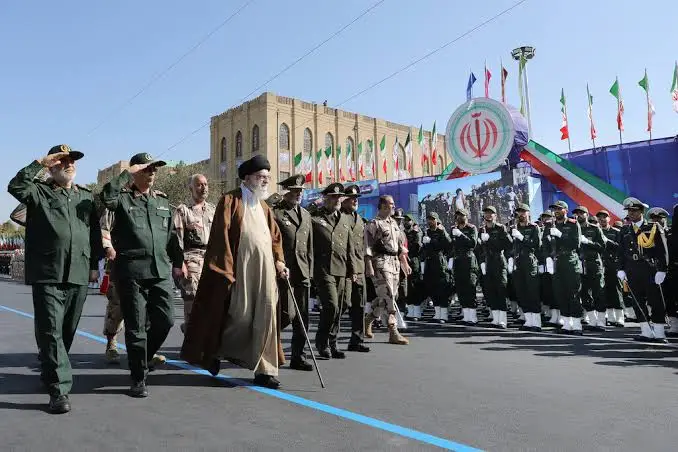
Iran has absorbed several waves of large-scale strikes and still retains asymmetric retaliation capacity; Iran military capabilities is degraded but not collapsed. Every conventional strike that fails to end the regime, reinforces Iran’s nuclear justification – making this the most important variable to consider.
Two waves of large-scale airstrikes launched by the United States and Israel — first in June 2025, then on February 28, 2026, in an operation known as Epic Fury — have substantially reshaped the landscape of Iranian military power.
Yet the degradation is not terminal. A strategic assessment released by LAB 45 on March 5, 2026, concluded that Iran, despite suffering significant capability losses, still retains asymmetric retaliation capacity and a strategic reconstruction potential that cannot be dismissed.
This article presents a comprehensive assessment of Iran’s military condition based on that document, focusing on force structure, strategic assets, proxy networks, and forward scenario projections.
Iran’s Military Capabilities Posture: Before and After the Strikes
Before the military escalation began, Iran ranked 16th in global military power. With approximately 610,000 active personnel, 350,000 reserves, and a defense budget exceeding $8 billion, Iran was a regional force taken seriously in Middle Eastern security calculations.
Iran’s armed forces are structured around two parallel components. First, the Artesh (Regular Armed Forces), tasked with conventional territorial defense, encompassing ground forces, the air force, and the regular navy. Second, the Sepah — the Islamic Revolutionary Guard Corps (IRGC) — which controls strategic missile forces, the Basij, the Quds Force, and an IRGC navy built around asymmetric tactics. The IRGC is not merely a military institution; it is a dominant political-ideological actor within the architecture of the Islamic Republic.
Following two waves of strikes, this balance of power shifted materially. The ballistic missile inventory, estimated at 3,000 units before 2025, fell to an estimated 1,500–2,000 units by February 2026. More significantly, approximately two-thirds of missile launchers were reportedly destroyed. Nuclear enrichment facilities at Natanz, Fordow, and Isfahan sustained heavy damage. The regional proxy network known as the Axis of Resistance was operating at its lowest capacity in a decade.
Missile Capabilities and Drone Systems
Despite the degradation suffered, Iran’s missile capabilities cannot be reduced to mere statistics. Iran is estimated to still be capable of producing several hundred missiles per month — indicating that the domestic defense industrial base has not been fundamentally crippled.
Key missile systems still in operation include the Shahab-3 with a range of approximately 2,000 km; the precision variants Ghadr and Emad; the solid-fueled Sajjil-2 with a 2,200 km range; the Fattah-1, designed with hypersonic glide capability and a 1,400 km range; and the Kheibar Shekan, a high-precision system with a 2,000 km range.
In the drone domain, Iran has in fact maintained a relatively strong position. The country is recognized as one of the global leaders in drone development and mass production. The Shahed-136, a one-way loitering munition with a 2,000 km range, has been launched more than 38,000 times in the Russia-Ukraine conflict alone. A joint Iran-Russia production facility at Alabuga has a capacity of approximately 10,000 units per year at a unit cost of around $193,000 — remarkably cost-efficient compared to Western precision systems.
Beyond the Shahed-136, Iran’s drone inventory includes the Shahed-129 for ISR and strike missions, the Mohajer-6 exported to Russia and proxy groups, the Karrar for strike roles, and the Ababil-3 designed for tactical swarm operations.
In the cyber domain, reports indicate increasing frequency and sophistication of Iranian cyber operations against Israeli and American infrastructure — signaling a shift in investment toward non-kinetic domains as compensation for conventional degradation.
Nuclear Program Status: Degraded, Not Eliminated
Iran’s nuclear program is the most strategically significant and analytically complex domain to assess. Before the June 2025 strikes, Iran had accumulated approximately 441 kilograms of uranium enriched to 60 percent purity.
The U.S. Defense Intelligence Agency (DIA) assessed in May 2025 that Iran had the potential to produce weapons-grade uranium for one device in less than one week. The Office of the Director of National Intelligence (ODNI) stated in November 2024 that Iran possessed sufficient fissile material for more than a dozen nuclear weapons if enriched further.
The airstrikes significantly degraded Iran’s material production capacity. Facilities at Natanz, Fordow, and Isfahan sustained severe structural damage, and production of high-purity uranium was reported to be severely hampered.
However, three factors indicate the program is not in a permanently eliminated state.
First, the scientific expertise and human capital behind Iran’s nuclear program — the most critical and hardest-to-destroy asset — remains intact.
Second, underground fortification is accelerating: the Fordow site inside a mountain continues to be reinforced, and a new facility dubbed “Pickaxe Mountain” is being excavated near Natanz.
Third, between December 2025 and January 2026, a surface site at Isfahan was reconstructed with a structure identical to the centrifuge facility at Karaj, demonstrating commitment to restoring production capacity.
The LAB 45 assessment concludes that full facility reconstruction requires years, while achieving weapons-grade enrichment capacity requires only months — a temporal disparity with deeply serious policy implications.
Iran’s Proxy Networks and Doctrinal Shift
The Axis of Resistance — Iran’s network of proxies and strategic partners encompassing Hezbollah in Lebanon, Palestinian armed groups, Shia militias in Iraq, the Houthis in Yemen, and various actors in Syria — has experienced significant collective degradation since October 2023.
Hezbollah, once regarded as Iran’s most capable proxy asset, is now in a severely degraded state. Its senior leadership was decimated in a series of targeted operations, its military infrastructure was destroyed, and its retaliatory strike capacity has been substantially neutralized.
In Syria, the fall of the Assad regime in December 2024 severed the overland corridor that served as Iran’s strategic logistics route to the Mediterranean. Palestinian groups, particularly Hamas, have faced intense pressure from sustained IDF operations throughout 2025. Iraqi militias have experienced fragmentation, particularly following the elimination of several senior commanders in February 2026.
The sole component of the Axis of Resistance still maintaining relatively significant operational capability is the Houthis in Yemen. This group continues to launch drone and missile strikes against shipping lanes in the Red Sea, sustaining pressure on vital global trade routes.
Responding to this shifting landscape, General Mousavi stated in 2026 that Iran had formally shifted its doctrinal orientation from defensive to offensive, adopting the principles of asymmetric warfare as its primary paradigm. In this context, the maritime route through Yemen has become the primary proxy logistics channel, substituting for the severed Syrian land corridor.
The Differential Reconstruction Doctrine
The LAB 45 assessment identifies a strategic response pattern described as the “Differential Reconstruction Doctrine,” operating simultaneously along three tracks.
The first track is diplomatic perception management: Iran consistently signals willingness to negotiate with the West while simultaneously continuing military reconstruction activities. This ambiguity is instrumentally exploited to gain the space and time needed for capability recovery.
The second track is accelerated military reconstruction, with priority given to rehabilitating layered air defense systems — encompassing the Bavar-373 (S-300 equivalent), S-300PMU-2, Khordad-15, and Sayyad-3 — alongside replenishing ballistic missile inventories to restore deterrence capacity following degradation.
The third track is deepening fortification of the nuclear program. By relocating critical nuclear assets to progressively deeper underground facilities, Iran seeks to place the program beyond the effective reach of any conventional air campaign.
The Geopolitical Dimension: The CRINK Framework
Assessing Iran’s capabilities cannot be separated from the geopolitical alliance context that frames it. The CRINK framework — China, Russia, Iran, North Korea — represents an increasingly structured axis of defense cooperation and diplomatic coordination.
Within this framework, Russia supplies air defense components and may potentially deliver up to 48 fourth-generation Su-35 fighter jets to Iran — a transfer that, if realized, would materially enhance Iran’s air capabilities. In return, Iran supplies Shahed drones for Russian military operations in Ukraine through the Alabuga production facility.
In October 2025, CRINK nations collectively declared the end of the JCPOA and stated that UN sanctions no longer carried binding legal force within their framework.
The strategic implication is that unilateral and multilateral Western pressure on Iran faces growing limitations in effectiveness, given the availability of an increasingly solid network of material support and diplomatic protection.
The Strategic Paradox: Nuclear Deterrence as Logical Consequence
The LAB 45 assessment identifies a strategic paradox with deeply serious long-term policy implications. Every conventional strike that successfully degrades Iran’s military capabilities, but fails to end the ruling regime, indirectly strengthens Iran’s strategic calculus to prioritize the acquisition of nuclear capability as the ultimate deterrent.
The strategic logic underpinning this paradox is coherent: Iran has empirically demonstrated that the possession of substantial conventional capabilities does not provide adequate protection against large-scale airstrikes. From Tehran’s strategic calculus, the absence of weapons of mass destruction has demonstrably failed to deter external intervention.
The logical consequence of this lesson is an increasing ideological and strategic justification for Iran to prioritize achieving nuclear capability as a more reliable deterrent.
This paradox has direct implications for the effectiveness of the coercive denial strategy long employed by the United States and Israel: each cycle of strikes and reconstruction potentially reinforces, rather than undermines, Iran’s determination to acquire nuclear capability.
Scenario Projections
In the short term (0–3 months), conditions of high volatility are projected to continue. The probability of Iranian retaliatory strikes against Israel, U.S. military installations in the region, or Gulf state infrastructure is assessed as significant, though with more limited accuracy than before 2025. Iran’s internal situation is also in a vulnerable state: the death of Supreme Leader Khamenei and the loss of several senior commanders raises the prospect of a succession crisis, while a domestic crackdown reported to have killed more than 36,000 people signals unprecedented internal pressure.
In the medium term (3–12 months), Iran’s reconstruction trajectory will be largely determined by three factors: the stability of post-Khamenei leadership, the continuity of material support from Russia and China, and the intensity of continued U.S. and Israeli operations. The still-functioning missile production capacity opens the possibility of gradual inventory recovery, while the underground nuclear program at Fordow and the Pickaxe Mountain site remain the most critical variables to monitor.
In the long term (12+ months), the most consequential scenario is one in which the regime survives and maintains continuity of power. In this scenario, commitment to the nuclear program is projected to intensify, with the program increasingly shielded inside underground facilities that are progressively beyond the effective reach of conventional air power. The CRINK framework has the potential to provide covert nuclear reconstruction support not easily countered by Western pressure.
Five Key Intelligence Assessments
Based on the overall assessment above, five key intelligence judgments can be formulated.
First, Iran has absorbed two waves of large-scale strikes and still retains asymmetric retaliation capacity; the regime is degraded but not collapsed.
Second, the nuclear program is the most consequential reconstruction priority, and the accelerating deepening of underground fortification makes future kinetic interdiction increasingly difficult technically.
Third, the Axis of Resistance has suffered significant structural weakening, but has not been eliminated; the Houthi maritime threat and Iraqi militia pressure remain credible multi-front instruments.
Fourth, the CRINK framework provides Iran with material and diplomatic protection that limits the effectiveness of unilateral Western pressure.
Fifth, the strategic paradox identified — that every conventional strike failing to end the regime reinforces Iran’s nuclear justification — is the most important variable to be considered in future policy formulation.
*This article was prepared based on the strategic assessment document “Iran 2026: Iranian Military Capability,” published by LAB 45 on March 5, 2026, authored by Indonesian Military Expert, Andi Widjajanto.