
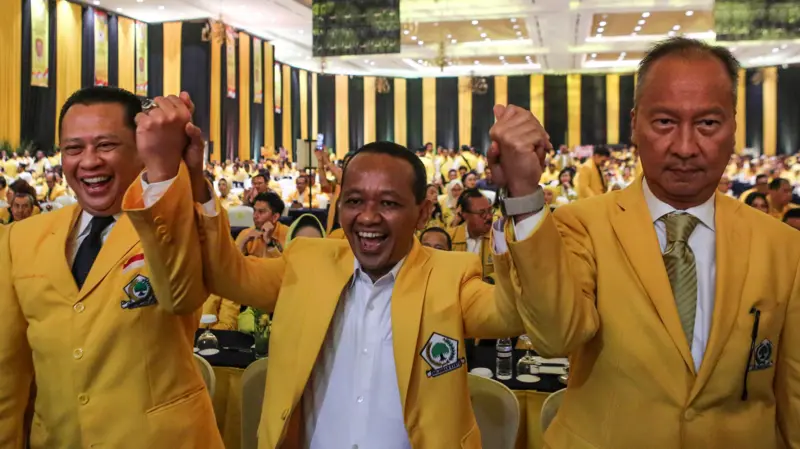
The Golkar Party stands as one of the most effective instruments for oligarchy in Indonesia to secure their interests.
The 1998 Reformation brought great hope for a more democratic Indonesia. However, 27 years later, we are witnessing a concerning phenomenon: our democracy is increasingly dominated by a handful of oligarchs—ultra-wealthy individuals who use their riches to control national politics and policy.
Amidst this, the Golkar Party stands as one of the most effective instruments for oligarchy in Indonesia to secure their interests.
From Soeharto’s Political Machine to a Vehicle for Oligarchy in Indonesia
Golkar has a unique history. Formerly, the party was Soeharto’s political engine, consistently winning elections with 60-70 percent of the vote through bureaucratic mobilization and various forms of political pressure.
When Soeharto fell, many predicted Golkar would collapse with him. It did not. Instead, the party successfully adapted to the new political landscape.
Interestingly, while Golkar adopted more open and democratic mechanisms for electing its chairperson, as historian David Reeve noted, “Golkar transformed into a party and was taken over by businessmen.” This means that while the procedures are democratic, the substance remains oligarchic.
The figures competing within Golkar are those with massive financial power: Aburizal Bakrie (energy conglomerate), Jusuf Kalla (property tycoon), Airlangga Hartarto (manufacturing tycoon), and now Bahlil Lahadalia (mining tycoon).
Indonesian Oligarchy: Wealth That Controls Politics
Jeffrey Winters, a political science professor at Northwestern University, defines oligarchy as a concentration of power based on extreme wealth. In Indonesia, this oligarchy operates systematically.
Data shows that nearly half of the members of the House of Representatives (DPR) for the 2019-2024 period were business owners controlling over a thousand companies. Even more shocking, 80 percent of the 2024 Presidential Election campaign funds originated from conglomerates.
Imagine, the four richest people in Indonesia possess wealth equivalent to that of 100 million poor citizens. While the national economy slows down, the wealth of the 50 richest conglomerates has skyrocketed. This is no accident—it is the result of a system designed to benefit those with access to political power.
The Job Creation Law: A Gift to Oligarchy in Indonesia
The clearest example of how the oligarchy operates is the Job Creation Law (UU Cipta Kerja) passed in October 2020. Golkar was one of the primary supporters of this controversial law in the DPR. Indonesia Corruption Watch noted that the deliberations were conducted behind closed doors and in a rush, with the public facing limited access to participate.
The result? A law that heavily favors large corporations. Environmental Impact Assessments (AMDAL) are no longer a primary requirement for mining business permits. Licensing authority was moved from regional to central government, making it easier for oligarchs as they only need to lobby the central administration.
Workers’ rights were weakened through reduced severance pay and increased overtime hours. Meanwhile, investment in the forestry sector increased more than 15-fold in five years—mostly benefiting those close to power.
Bahlil Lahadalia: A Clear Conflict of Interest
The case of Bahlil Lahadalia serves as a perfect illustration of this issue. As the Chairperson of Golkar and the Minister of Energy and Mineral Resources (ESDM), Bahlil possesses wealth exceeding Rp310 billion with extensive nickel and coal mining businesses. His company, PT Rifa Capital, explores 39,000 hectares of coal mining land in West Papua and 11,000 hectares of nickel land in Halmahera.
How can someone who regulates national mining policy also own businesses in the same sector? This is a blatant conflict of interest. When criticized, Bahlil retorted, “Don’t you dare say we are an oligarchy. Just wait, once you become an official or a rich person, perhaps your behavior will be more wicked than mine.” This statement is not just arrogant—it is a normalization of oligarchic behavior that we should reject.
Exploitation of Natural Resources
Reports from the Mining Advocacy Network (JATAM) reveal a complex network of nickel mining companies in Halmahera linked to Golkar elites. In Central Halmahera, 66 mining business permits control nearly 143,000 hectares of land. The impact? The Sangaji River has turned brownish-red, destroying the community’s drinking water source.
Indigenous communities like the O’Hongana Manyawa are losing their living space. Citizens who resist mining on their ancestral lands are criminalized.
This is not just about environmental destruction. It is about how Indonesia’s natural wealth, which should be for the people—as mandated by Article 33 of the 1945 Constitution—is instead drained by a few individuals with political access.
Golkar: Always With the Ruler
Since the Reformation, Golkar has shown a consistent pattern: it always aligns with whoever is in power. From the eras of Gus Dur, Megawati, SBY, and Jokowi, to now Prabowo—Golkar is always part of the government coalition. This is not political loyalty based on ideology, but pragmatism to maintain access to power and economic resources.
Each time it joins a government, Golkar and its resident oligarchs secure strategic ministerial positions, mining permits, plantation land use rights, infrastructure contracts, and regulations that protect their businesses. This pattern creates a dangerous cycle: political support is swapped for economic access, which is then used to fund the next political campaign.
Oligarchic dominance threatens the substance of our democracy. Democratic institutions like the KPK (Anti-Corruption Commission) are weakened. Public participation spaces are restricted. Environmental activists defending community rights are criminalized—Amnesty International recorded 128 political prisoners in Indonesia, mostly due to social media criticism.
Public policy no longer reflects the interests of the people, but the interests of a few elites. Economic inequality worsens. Elections have shifted from a platform for public participation into a battlefield for transactional interests. Our democracy has become “hollow”—an electoral ritual without substance, where real power remains in the hands of a few oligarchs.