
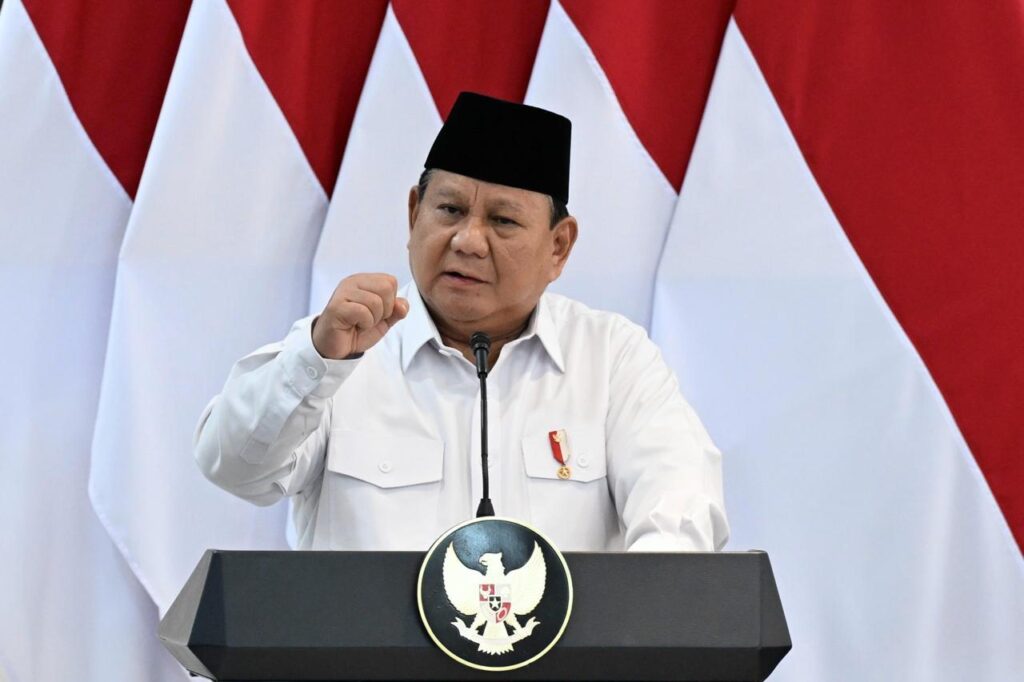
President Prabowo appears to be inspired by Lee Kuan Yew’s model of economic pragmatism. This is evident in the policies adopted through bureaucratic efficiency, strict oversight of corruption, and state-led economic development.
Singapore under Lee Kuan Yew’s administration is often cited as an example of the East Asian model of economic development. Massive economic development was driven by meritocracy and economic pragmatism.
Lee Kuan Yew successfully transformed Singapore from a poor nation into one of the world’s strongest economies in a short time. The keys were discipline, rule of law, corruption eradication, and attracting foreign investment. However, this progress was achieved at the cost of sacrificing certain civil and political freedoms—the press was muzzled, opposition was restricted, and state control was very strong.
President Prabowo appears to be inspired by Lee Kuan Yew’s model of economic pragmatism. This is evident in the policies adopted through bureaucratic efficiency, strict oversight of corruption, and state-led economic development.
However, there are fundamental differences between the two countries. Indonesia is not a city-state like Singapore. Indonesia is an archipelagic nation with 270 million people, with extraordinary complexity in ethnic, religious, and cultural diversity. The centralized authoritarian model that succeeded in Singapore may not be suitable for implementation in Indonesia.
Moreover, the historical contexts of the two countries differ. Singapore built from scratch without an entrenched oligarchic legacy. Meanwhile, Indonesia inherited an economic-political structure that was formed since the New Order under Soeharto’s administration, with a sprawling oligarchic network.
Lee Kuan Yew did not need to face powerful domestic conglomerates. He instead attracted foreign conglomerates to invest in his country. Prabowo must confront local oligarchs who possess both political and economic power simultaneously.
Another important difference concerns democracy. Singapore under Lee Kuan Yew chose a limited democracy model for the sake of stability and economic growth. Post-Reformation Indonesia has chosen the path of democracy as a non-negotiable system.
Prabowo, despite having a firm style, must work within the framework of constitutional democracy with parliament, an independent judiciary, and an active civil society.
Between Prosperity and Democracy, Prabowo’s Way
One dangerous narrative that often emerges is the dichotomy between economic prosperity and democracy. This narrative implies that to achieve prosperity, people must be willing to sacrifice their democratic rights. The Singapore model is frequently used as justification.
Singapore as an authoritarian state can prosper, while democratic states can stagnate. However, this narrative is wrong and misleading. Prosperity and democracy must go hand in hand and mutually reinforce each other.
Democracy without prosperity will be fragile, vulnerable to populism and instability. Conversely, prosperity without democracy will create power imbalances that ultimately give rise to new injustices.
Indonesia does not need to choose between democracy and prosperity. What is needed is effective democracy, not just procedural, but substantive. Democracy that is capable of producing public policies that bring prosperity, where the people’s voices are truly heard, not only during elections but in daily decision-making processes.
Public participation, government transparency, accountability of state institutions, press freedom, and space for civil society are elements that actually strengthen economic development.
Several studies show that countries with high democracy indices tend to have more inclusive and sustainable economic growth. Corruption, for instance, is easier to eradicate in countries with a free press and independent oversight institutions.
Prabowo and his administration must understand that the path to people’s prosperity does not have to sacrifice democracy. On the contrary, strengthening democracy—by reinforcing checks and balances institutions, guaranteeing freedom of expression, involving people in public policy—will create a more solid foundation for fair and equitable economic development.
Economic Burdens That Prabowo Must Be Resolved
The economic challenges inherited by Prabowo are not light. Currently, national debt continues to swell. Although Indonesia’s debt-to-GDP ratio is still within safe limits according to international standards, the upward trend in debt needs to be watched carefully, especially amid the weakening rupiah exchange rate and rising global interest rates. Debt principal and interest payments erode fiscal space that should be used for social programs and infrastructure.
Then, there is the fluctuating trade deficit. Dependence on imports, especially energy and food, makes Indonesia vulnerable to global price shocks. Energy crises due to geopolitical conflicts or rising world food prices can directly hit the domestic economy. The food self-sufficiency program is one solution, but this requires time and substantial investment.
The level of unemployment and quality of employment in Indonesia also remains a crucial issue. Although the open unemployment rate is relatively low, many workers are trapped in informal jobs with low wages and no social security. The demographic bonus that should be an asset could instead become a burden if quality jobs are unavailable. Investment in vocational education and entrepreneurship becomes important to realize.
In Indonesia, social inequality is also still significant. Although absolute poverty has decreased, the gap between rich and poor groups remains wide. A small portion of the population controls most of the wealth, while millions of people still live below the poverty line or are vulnerable to falling into poverty. This inequality is not just about statistical figures, but also about social justice.
Indonesia also needs structural reform in economy. Indonesia’s economy is still heavily dependent on the extractive sector and raw commodities. The industrial downstream project that is being promoted is indeed important, but its implementation is still far from optimal.
Convoluted bureaucracy, corruption, and legal uncertainty make the investment climate less conducive. Without comprehensive structural reform, Indonesia will find it difficult to escape the middle-income trap.
People’s Hope on Prabowo’s Administration
Prabowo Subianto’s leadership stands at a crossroads. On one hand, there is hope that his firmness and political strength can be used to fight oligarchy and realize social justice. Programs such as food self-sufficiency and Free Nutritious Meals show an impression of siding with the people.
On the other hand, the challenges faced are enormous. Starting from the entrenched oligarchic legacy, heavy economic burdens, and the temptation to sacrifice democracy for the sake of stability and development.
Indonesia does not need to choose between prosperity and democracy. Both must go hand in hand. The authoritarian model à la Lee Kuan Yew may have succeeded in Singapore, but Indonesia has a different context. And Indonesia has chosen the path of democracy.
What is needed is effective democracy, capable of producing public policies that bring prosperity without sacrificing civil rights and public participation.
Prabowo has strong political capital. However, that strength must be used wisely to carry out structural reform, eradicate corruption, reorganize wealth distribution, and build an inclusive economy. Amid the flood of public criticism, hope for Prabowo still exists, but that hope must be accompanied by critical vigilance.
Prosperity will come not from only a strong leader, but from a fair, transparent, and accountable system. And such a system can only be built if the people and government work together, within the framework of a strong and living democracy.