
Indonesia’s Attorney General arrested the head and two former deputy heads of the National Nutrition Agency on Wednesday on corruption charges — exposing an alleged scheme of shell foundations, rigged procurement, and price inflation at the very center of President Prabowo’s flagship free nutritious meals program.
JAKARTA — Indonesia’s Attorney General’s Office arrested the head and two former deputy heads of the National Nutrition Agency (Badan Gizi Nasional, BGN) on Wednesday on corruption charges, dealing a severe blow to President Prabowo Subianto’s flagship Free Nutritious Meals (Makan Bergizi Gratis, MBG) program — a flagship initiative backed by some 353 trillion rupiah (approximately $21.5 billion) in budget allocations over two years.
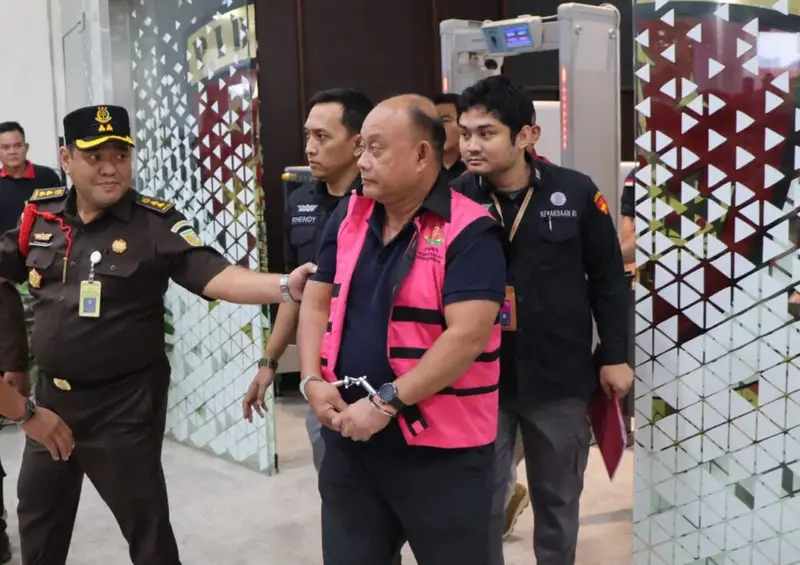
The three suspects — Dadan Hindayana, the agency’s chief, and former deputies Lodewyk Pusung and Sony Sonjaya — were taken into custody less than 24 hours after President Prabowo removed them from their posts, and were paraded before cameras in the pink vests customarily worn by detainees at the Attorney General’s Office.
Video footage that spread rapidly on social media Wednesday night showed Dadan Hindayana, dressed in a black polo shirt, being escorted by armed officers from his home in Bogor shortly before midnight. By the following afternoon, he had been formally named a suspect.
Lodewyk Pusung was detained at his residence in the Matraman district of Jakarta, while Sony Sonjaya was apprehended at a hotel in the capital. All three refused to answer questions from reporters as they were led to detention vehicles.
Dadan emerged from the Attorney General’s building in handcuffs at around 5:12 p.m. local time. Lodewyk and Sony followed minutes later — Sony briefly retreating back inside amid a press scrum before being escorted out about 15 minutes afterward.
Who Are the Suspects?
Dadan Hindayana, born in Garut in 1967, was an entomologist and former academic at the prestigious Bogor Institute of Agriculture (IPB), where he graduated top of his class in 1990. He later earned a doctorate in applied entomology from Leibniz University Hannover in Germany. Prior to his arrest, he had reported personal assets of 9.02 billion rupiah with no listed liabilities.
His two deputies brought different credentials to the agency. Sony Sonjaya was a retired Inspector General of the National Police, while Lodewyk Pusung was a retired Lieutenant General of the Indonesian Army. The arrests of an academic and two retired generals within the same institution have heightened the scale of the scandal.
The Alleged Scheme
Prosecutors laid out a three-pronged pattern of alleged corruption at a press conference Wednesday.
Shell foundations. Investigators allege that foundations with undisclosed ties to the three suspects were approved as program partners despite failing to meet eligibility requirements. The suspects are accused of intervening in the BGN’s partner verification portal to ensure their affiliated foundations passed screening. Through this arrangement, these foundations allegedly received incentive payments running into billions of rupiah daily.
“The foundations were owned by the suspects through third parties or controlled by others, creating a conflict of interest,” said Syarief Sulaeman Nahdi, Director of Investigations at the Attorney General’s Office.
Procurement interference. Prosecutors allege the trio unlawfully intervened in the agency’s procurement processes, pressuring officials known as Pejabat Pembuat Komitmen (PPK), or commitment-making officers, to steer contracts in their favor.
Inflated procurement. Investigators identified a wide range of goods allegedly procured at marked-up prices, including 21,801 electric motorcycles valued at approximately 1 trillion rupiah, 32,000 pairs of shoes, more than 31,000 tablet computers, and 5,400 units of 75-inch televisions. Investigators found that the procurement of tablets had been arranged through manipulation of terms of reference and did not reflect actual field requirements.
“There was also price mark-up in procurement, resulting in financial losses that undermined MBG operations,” Syarief said
Free Nutritious Meals Program Under Scrutiny
The MBG program, one of Prabowo’s most prominent campaign promises, was designed to provide free nutritious meals to schoolchildren across Indonesia. The arrests follow a trail of earlier controversies surrounding BGN’s leadership.
In May 2025, Dadan drew public ridicule after publicly describing his personal habit of drinking two liters of milk per day — a tone-deaf remark, critics said, given the economic realities facing most Indonesian families. During Ramadan, reports and social media posts indicated that meals distributed under the program consisted of little more than bread, instant cereal, two dates, and a boiled egg — falling short of nutritional ideals for fasting children.
Those controversies now appear to have been surface symptoms of deeper dysfunction.
Reaction from the Palace
Presidential Chief of Staff Dudung Abdurrachman told reporters at the parliamentary complex in Jakarta on Wednesday that President Prabowo had long been monitoring the situation within the agency.
“I am confident this is for improvement going forward, so that BGN becomes more transparent, accountable, and truly fulfills the President’s wishes — this is the people’s money, and it must be properly safeguarded,” Dudung said.
He added that Prabowo had repeatedly warned against any misappropriation of the program’s funds, and had made clear he did not want MBG to benefit any individual or group’s private interests.
A Five-Day Investigation
According to reporting by Kompas.id, the investigation began on May 29, 2026. The three were initially questioned as witnesses before being formally designated as suspects once prosecutors had gathered sufficient evidence. Prabowo removed them from their positions on Tuesday, June 2 — one day before the formal charges.
“The investigation was elevated to a full probe just a few days ago,” Syarief confirmed.
The suspects face charges under Article 603 and Article 604 of the Criminal Code, in conjunction with Article 20 of the same code, as well as Article 18 of Indonesia’s Anti-Corruption Law.
Broader Implications
For program partners in the field, the arrests confirmed long-held suspicions. A meal service provider in Central Java told Republika that irregularities were likely not confined to one region, based on information from a network of kitchen operators across the country. Many local partners, the provider said, had been struggling and felt they were being shortchanged.
Analyst Erizal, director of ABC Research & Consulting, was blunt in his assessment. “They were far too bold,” he said. “Every day, the entire country was watching the MBG program.”
The arrests mark a significant stress test for what was meant to be one of the Prabowo administration’s most visible achievements — a program designed to nourish millions of schoolchildren each morning. The revelation that funds earmarked for those children may have been siphoned off by the very officials entrusted with the program’s integrity has shaken public confidence.
Prosecutors have yet to disclose the total estimated value of state losses. The investigation is ongoing.