
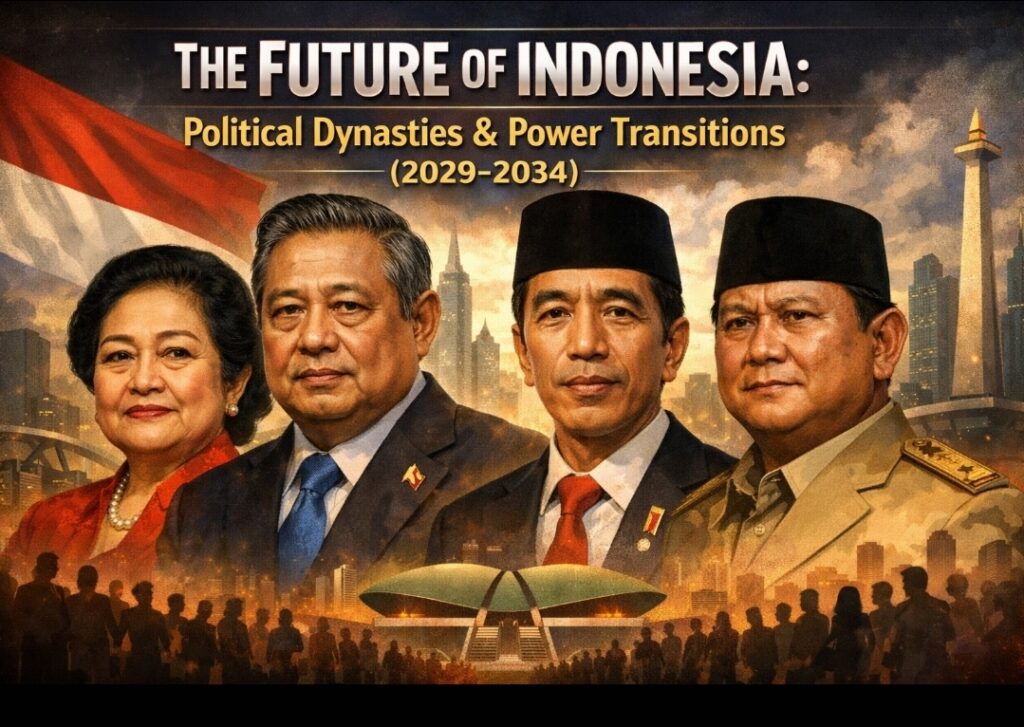
The period from 2026 leading up to the next two presidential elections in 2029 and 2034 represents a crucial juncture for Indonesia’s political future. A number of veteran Indonesian political elites who have occupied the inner circle of power—many since the 1998 Reformasi—are entering their twilight years. How will the power transition unfold in their wake?
A cadre of what we might call Indonesia’s “super-elites”—former Presidents Megawati Sukarnoputri, Susilo Bambang Yudhoyono (SBY), and Joko Widodo (Jokowi); former Vice President Jusuf Kalla; NasDem Party Chairman Surya Paloh; and current President Prabowo Subianto—are now over 70 years old.
These figures sit at the epicenter of Indonesian power and have established distinct political lineages (trah). With the exception of Jusuf Kalla, who once chaired the Golkar Party, all the names mentioned are effectively the “owners” of Indonesia’s major political parties.
Nearly all of them have devised transition schemes to hand power to their children or designated heirs—a phenomenon that reinforces dynastic politics in Indonesia.
Megawati Sukarnoputri has propelled her daughter, Puan Maharani, to the position of Speaker of the House (DPR-RI). Meanwhile, her son, Prananda Prabowo, though less public-facing, maintains a firm grip over the internal machinery of the PDI-P.
SBY has managed a relatively smooth transition to his son, Agus Harimurti Yudhoyono (AHY). After handing over the chairmanship of the Democratic Party, AHY secured Prabowo’s victory as a coalition partner. In turn, Prabowo appointed AHY as the Coordinating Minister for Infrastructure and Regional Development—a move seen as “reciprocity” for his party’s support.
Jusuf Kalla and Surya Paloh appear less certain to secure high-prestige political appointments for their heirs in the immediate future. While Surya’s son, Prananda Paloh, serves in the DPR-RI, he has yet to emerge as a prominent national figure despite his father’s status as a media tycoon and party leader. Similarly, Kalla’s nephew, Erwin Aksa—a capable businessman and Golkar politician—has yet to find the “special spark” required to dominate the national stage.
Joko Widodo presents an interesting case. Through a shortcut that many critics view as overly “instant,” he ensured his eldest son, Gibran Rakabuming Raka, became Vice President. Furthermore, he installed his younger son, Kaesang Pangarep, as Chairman of the Indonesian Solidarity Party (PSI), effectively “acquiring” the party. His son-in-law, Bobby Nasution, also secured the governorship of North Sumatra.
Prabowo Subianto has not directly handed a political legacy to his son. Instead, he has built a massive power network through the Gerindra Party and military-subordinate ties. Prabowo is grooming several figures as the new elite. Within Gerindra, Sufmi Dasco Ahmad acts as the primary operator orchestrating party power. More recently, Prabowo elevated Sugiono—the current Foreign Minister and a former army officer—to Secretary General of Gerindra. Sugiono is increasingly seen as the frontrunner to inherit the party’s leadership.
Dynastic Politics and the Reproduction of the Indonesian Elite
Dynastic politics has become an unavoidable reality in Indonesia. The crystallization of family-based power lineages is driven by the private “ownership” of political parties. Ideally, parties are democratic institutions belonging to members and constituents—and by extension, the people. Instead, they have devolved into personal and family assets.
These parties are the primary engines for the reproduction of power, maintaining the status quo through dynastic succession. They serve as the birthplace for new elites, providing access to political concessions, public office, and economic resources. For those seeking power or capital, there is often no choice but to show total fealty to the “party owner.” This interlocking system ensures that the old guard’s influence and the culture of dynasty remain deeply entrenched.
The Ideological Colors of the Political Lineages
By 2029 and 2034, Indonesia’s political contest will likely narrow down to a few primary factions.
The Megawati Lineage (PDI-P) symbolizes the revolutionary spirit of Sukarno, Marhaenism, and grassroots nationalism. As the “Party of the Little People” (Wong Cilik), it maintains a robust network among rural and lower-income voters. Its identity remains “Red,” with Sukarno as its ultimate icon.
The SBY Lineage (Democratic Party) defined as Nationalist-Religious, its “Blue” branding mirrors the centrist-technocratic spirit of the U.S. Democratic Party—emphasizing market economics, civil supremacy, and institutional openness. This is the legacy AHY is expected to uphold.
The Prabowo Lineage embodies national stability and development, echoing the New Order era of Suharto. Prabowo’s focus on food self-sufficiency and programs like “Free Nutritious Meals” reflects Suharto-era developmentalism. However, he also carries the influence of his father, the economist Sumitro Djojohadikusumo, leaning toward state-led economic development (socialism-democracy), as seen in the creation of Danantara, the national sovereign wealth fund.
The Jokowi Lineage defined by populism. Jokowi is the “outsider” from the grassroots whose “blusukan” (impromptu visits) and social assistance programs (Bansos) define his brand. Gibran appears to be mirroring this populist persona as the primary heir to this lineage.
Moving forward, these lineages will compete for the presidency. While there is significant potential for shifting coalitions and partnerships between them, the space for intense rivalry remains wide open. To succeed, these heirs must do more than just preserve their inherited brands; they must adapt to the challenges of a new era to sustain their grip on power.