
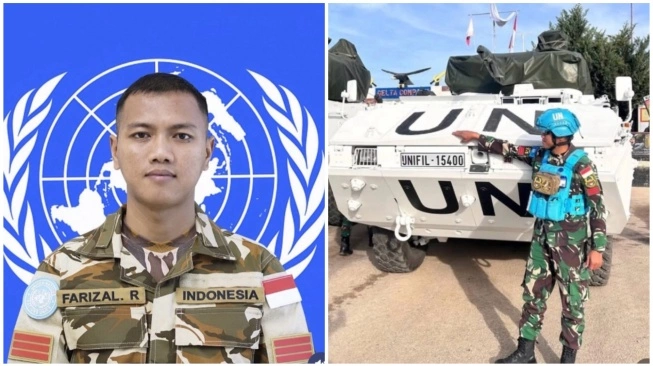
Three soldiers of the Garuda Contingent were killed in Lebanon within 24 hours. This incident is not merely a national tragedy—it exposes the deepest contradiction in Indonesia’s diplomacy: Indonesia is in The Board of Peace, sponsored by a country accused of killing its own soldiers.
Saturday night, March 29, 2026. At a guard post near the village of Adshit al-Qusayr, South Lebanon, an artillery projectile exploded. Chief Private Farizal Rhomadhon, a member of Company C UNP 7-1 Task Force Battalion XXIII-S of the Garuda Contingent, died instantly.
Three of his comrades—Private Rico Pramudia, Private Bayu Prakoso, and Private Arif Kurniawan—were injured, one of them critically. The following day, another explosion struck a UNIFIL logistics convoy near Bani Hayyan.
Two additional Indonesian soldiers were killed. In less than 24 hours, three Indonesian lives ended on Lebanese soil—making this period the deadliest for the Garuda Contingent throughout the history of Indonesia’s participation in United Nations peacekeeping missions.
Lebanon’s National News Agency (NNA) reported that Israeli artillery fire directly targeted the Indonesian contingent base serving alongside UN forces. United Nations Secretary-General António Guterres confirmed the incident, while UNIFIL spokesperson Kandice Ardiel stated that an investigation was underway. Israel suggested that the deaths might not necessarily be the result of its actions, mentioning the possibility of Hezbollah involvement.
However, that statement does not change one harsh fact: UN soldiers wearing blue helmets died at their posts whose coordinates were known to all parties.
Chronology & Casualties — Garuda Contingent in Lebanon, 2024–2026
- October 10, 2024 — Marine Private Egy Arifianto and Private Nofrian Syahputra were thrown from Watchtower 14 in the Naqura Sector after being hit by an Israeli Merkava tank shell. Both managed to escape.
- March 6, 2026 — A Ghanaian post in Lebanon was struck by an Israeli missile; two Ghanaian soldiers were seriously wounded. The Israeli military admitted the tank fire was a mistake.
- March 29, 2026 — Private Farizal Rhomadhon was killed by an artillery attack in Adshit al-Qusayr. Three other soldiers were wounded.
- March 30, 2026 — Two additional Indonesian soldiers were killed in an explosion involving a UNIFIL logistics convoy vehicle near Bani Hayyan.
Indonesia in the Board of Peace: Diplomatic Ambition or a Geopolitical Trap?
To understand why the deaths of these three soldiers reverberate far beyond the military dimension, we need to go back to February 19, 2026. In Washington D.C., before United States President Donald Trump, President Prabowo Subianto officially declared that Indonesia would join the Board of Peace (BoP)—a multilateral forum initiated by Trump intended as a mechanism for stabilizing Gaza after a ceasefire. Indonesia even expressed its willingness to send up to 8,000 personnel to the International Stabilization Force (ISF), and to accept the position of Deputy Operations Commander within the ISF command structure.
Formally, the government relies on United Nations Security Council Resolution No. 2803 adopted on November 17, 2025 as the legal basis. Foreign Minister Sugiono emphasized that Indonesia’s presence in the BoP is based on mandates of stabilization, protection of civilians, humanitarian assistance, and Gaza reconstruction—not normalization of relations with Israel. This perspective is supported by some academics, such as international law expert from Satya Wacana Christian University, Theofransus Litaay, who argues that Indonesia’s participation is constitutional and cannot be interpreted as diplomatic recognition of Israel.
However, a wave of criticism from academics, civil society, and religious figures quickly followed. And when three Indonesian soldiers were killed by Israeli artillery under the same UN banner—while Indonesia sat at the same table with Israel in the BoP—the contradiction could no longer be hidden behind diplomatic language.
“By entering what can be called the trap set by Trump and Israel through our membership in the BoP, once we joined, Israel launched its attacks. This is a serious blow to our foreign policy.” Prof. Dafri Agussalim — Professor of International Relations, Faculty of Social and Political Sciences, Gadjah Mada University.
Voices of Experts
Long before the first bullet struck the Indonesian UNIFIL post, warnings from academic and civil society communities had already grown stronger. The deaths of the three soldiers are like the estuary of a river of criticism that has flowed since Indonesia first declared its willingness to join the BoP.
Vinsensio Dugis — International Relation Expert, Universitas Airlangga, “BoP is an extraordinary trap built by the United States under Donald Trump for many countries. This instrument is designed to increase the leverage of the United States as a great power. Indonesia failed to conduct careful calculations at the initial stage regarding the risks of joining.”
Prof. Nur Rachmat Yuliantoro — Professor of International Relations, UGM. “President Prabowo once stated that Indonesia could withdraw from the BoP if Palestinian independence was not achieved. However, before that goal even became reality, the US and Israel attacked Iran. This raises questions about the credibility and legitimacy of the BoP whose main actors are actually opening a new major conflict.”
From civil society circles, pressure also intensified. On March 1, 2026, as many as 65 public figures and 79 civil society groups—including the Human Rights Working Group and Indonesia Corruption Watch—issued a petition titled “Resisting the New Imperialism.”
They rejected the deployment of Indonesian troops to Gaza without a UN Security Council mandate, arguing that the BoP referred to did not point to Resolution 2803 but was instead dominated by certain political interests. The Indonesian Ulema Council (MUI) even issued an official advisory urging the government to withdraw from the BoP, calling the forum a “Board of War.”
From the House of Representatives (DPR), calls for evaluation also strengthened after the deaths of the soldiers. Commission I member Yulius Setiarto stated that the incident in Lebanon should be a momentum for Indonesia to leave the BoP—because the countries driving the BoP have proven not to move in the spirit of peace. Another Commission I member, Oleh Soleh from the PKB faction, requested a comprehensive evaluation of the deployment of Indonesian troops in Lebanon, calling the incident a “humanitarian tragedy and a violation of the spirit of world peace.”
Government Response: A Late and Half-Hearted Condemnation?
The Indonesian government’s official response followed a familiar pattern: expressions of condolences, strong condemnation of the attack, and calls for a transparent investigation. Foreign Minister Sugiono—while accompanying President Prabowo on a working visit to Tokyo—expressed condolences for the death of “Private Farizal Ramadan” and condemned “this incident and the attacks carried out by Israel in southern Lebanon.” Indonesia’s Permanent Representative to the United Nations in New York was scheduled to meet with the UN Under-Secretary-General for Peace Operations to push for a comprehensive investigation and the repatriation of the bodies.
However, public criticism targeted the delay and lack of firmness in the government’s stance. International relations expert from Airlangga University Radityo Dharmaputra noted that several hours after the news of the soldiers’ deaths spread, there was still no direct statement from President Prabowo—even though a direct statement from the head of state is important to show the political position of the country, not merely a technical diplomatic response.
Meanwhile, Israel responded by suggesting that the deaths of Indonesian soldiers were not necessarily the result of IDF actions—opening the possibility that Hezbollah was responsible. The Israeli military stated it was investigating “two different incidents” to clarify whether the deaths resulted from Hezbollah activity or IDF actions. This statement was criticized by UNIFIL itself: the head of UN peacekeeping operations Jean-Pierre Lacroix emphasized that attacks on peacekeepers may constitute war crimes.
Palestine and Indonesia in the Board of Peace Paradox: Peace for Whom?
At the heart of this entire debate lies a question that cannot be answered by diplomatic protocol: is the Board of Peace truly a path toward Palestinian independence, or merely a stabilization mechanism designed to consolidate the outcome of war according to Washington and Tel Aviv?
Several structural indicators strengthen this doubt. Israel’s Foreign Minister in the BoP forum stated that the core of Trump’s plan is the disarmament of Hamas, the demilitarization of Gaza, and the “deradicalization” of Palestinian society—not the restoration of Palestinian political rights.
Impact and Implications: When Grief Becomes a Turning Point
More than just an individual tragedy, the deaths of these three Indonesian soldiers carry layered systemic implications—from defense policy to the posture of Indonesia’s foreign diplomacy in the years ahead.
Implications for personnel security and UNIFIL evaluation
Indonesia is the largest contingent within UNIFIL, with around 1,000 soldiers deployed on land and at sea in Lebanon. Since the UNIFIL mission began in 1978, more than 337 soldiers from various countries have died. The March 2026 incident marks a significant escalation: for the first time in the history of the Garuda Contingent, three lives were lost in a single day.
Not Merely Mourning: A Moment for Strategic Honesty
Praka Farizal Rhomadhon, along with the two soldiers who died the following day, did not die in a war Indonesia chose to join. They died in a UN peacekeeping mission that has long been a national pride—a concrete symbol of the constitutional aspiration to contribute to a world order based on independence, lasting peace, and social justice.
The irony is stark: the country accused of killing them is a partner in the same “peace” forum that Indonesia is now seeking to join.
There are no easy answers. Leaving the BoP carries real diplomatic risks with the United States in the context of sensitive economic negotiations. But staying without clear conditions, without a transparent UN Security Council mandate, without meaningful Palestinian representation—while soldiers continue to fall under Israeli attacks—will only drain the moral capital that has long been Indonesia’s greatest diplomatic asset.
Experts have spoken. The public has mourned. Parliament has begun to voice its concerns.
Is the March 2026 incident strong enough to force a moment of strategic honesty—that “peace” which is unjust to Palestine is not a peace worth defending with the lives of Indonesian soldiers?