
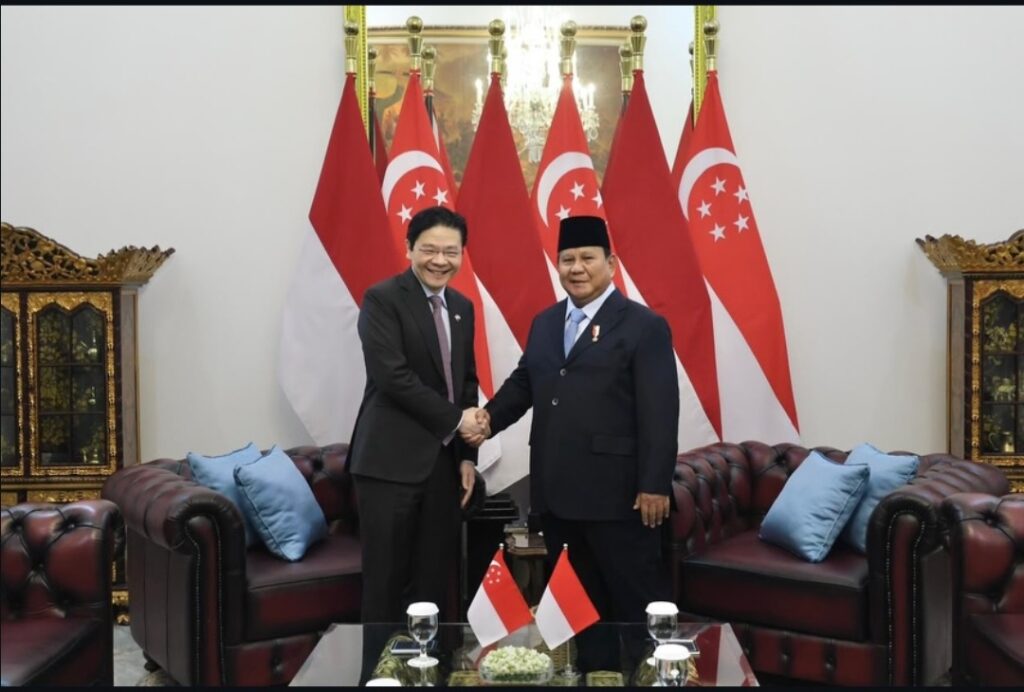
Rather than President Prabowo Subianto traveling to Singapore, it was Singaporean Prime Minister Lawrence Wong who flew to Jakarta on July 6, 2026, bringing five ministers with him for the second annual Indonesia-Singapore Leaders’ Retreat, hosted at Merdeka Palace. What is the important result from this meeting?
The first retreat under this format took place in Singapore in June 2025, when Prabowo made his own visit there — so the two countries have essentially been taking turns hosting each other on an annual basis. This piece covers both the freshest outcomes from the Jakarta retreat and the broader arc of the relationship, including Prabowo’s earlier visit to Singapore.
What Came Out of the Jakarta Retreat
The July 2026 meeting produced 26 agreements and memorandums of understanding, up from 19 signed at the inaugural retreat in Singapore the year before. That growth in volume alone signals an relationship that both governments are actively trying to deepen rather than let coast on goodwill.
Several themes stood out among the agreements:
- Energy cooperation. MoUs were signed between Indonesia’s sovereign wealth fund Danantara and Singaporean firms Keppel Electric and Sembcorp Industries, laying groundwork for cross-border electricity projects. Both leaders framed this as a building block toward a wider ASEAN Power Grid, tying bilateral cooperation to a larger regional energy security agenda.
- Defense and security. The Singapore Armed Forces and Indonesia’s TNI are exploring co-development of training facilities in Batu Raja, West Kalimantan, and expanding use of the Siabu Air Weapons Range — an extension of a defense relationship both sides credit partly to Prabowo’s own history as Indonesia’s former defense minister.
- People-to-people ties. Expansion of Prabowo’s Garuda Schools program, including exchanges between Singaporean universities and SMA Taruna Nusantara in Central Java.
- Maritime security. Both sides reaffirmed commitments under UNCLOS to keep the Strait of Malacca and Strait of Singapore open, safe, and accessible — a shared strategic interest given both countries’ status as littoral states along one of the world’s busiest shipping corridors.
- Regional diplomacy. With Singapore due to chair ASEAN next year, Wong indicated Singapore would consult closely with Indonesia — the bloc’s largest economy — in shaping that chairmanship agenda.
Notably absent from public disclosure were the specifics of many individual MoUs, with officials declining to detail all 26 documents. This isn’t unusual for retreats of this kind — the headline number often matters more politically than the granular content, since it signals momentum in the relationship.
The Long Arc: From Colonial-Era Roots to Strategic Partnership
Indonesia and Singapore’s relationship carries a personal dimension for Prabowo himself. He has spoken of spending part of his childhood in Singapore when it was still a British colony, and has long expressed admiration for founding leader Lee Kuan Yew, crediting him with building what Prabowo called a system of meritocracy across generations of leadership.
On his first state visit to Singapore, Prabowo was candid about wanting to “copy with pride” Singapore’s approach to housing and investment policy — an unusually direct admission from a head of state that a much smaller neighbor has lessons worth importing.
That admiration sits atop a genuinely institutionalized relationship. The annual Leaders’ Retreat format itself — something Wong has described as reflecting a “special relationship” built on trust and mutual understanding — is unusual in Southeast Asian diplomacy, where high-level bilateral summits are often sporadic rather than calendared. Defense ties in particular have decades of depth, with joint training arrangements predating the current administration.
Friendship With an Asterisk: The Economic Imbalance
Here is where the relationship gets more complicated, and where “friendship” and “competition” genuinely coexist. Singapore is not just a close partner to Indonesia — it is, by a wide margin, Indonesia’s single largest source of foreign direct investment, a position it has held for over a decade running:
In 2025, Singaporean FDI into Indonesia reached roughly $17.4 billion, about 30% of all foreign direct investment the country received that year — more than the next two largest sources (Hong Kong and China) combined.
This pattern held consistently through the year: Singapore led with $4.6 billion in Q1 2025, $8.8 billion cumulatively by August, and $3.8 billion in Q3 alone.
Singaporean capital is concentrated in Indonesia’s basic metals and downstream nickel processing industries, alongside significant flows into “other services,” mining, and transportation infrastructure.
There’s an important asterisk to this dominance, though, that Indonesian officials themselves acknowledge only quietly: a large share of “Singaporean” investment is understood to be round-tripped capital — money originating from Indonesian conglomerates or global investors that is routed through Singapore’s holding companies, favorable tax treatment, and sophisticated financial and legal infrastructure before flowing back into Indonesia.
Singapore’s efficient banking system, political stability, and status as Southeast Asia’s financial hub make it the preferred parking and channeling point for capital that is not, in an economic sense, purely foreign.
This is the crux of the “domination” dynamic the user is asking about. Singapore’s economic weight over Indonesia doesn’t primarily come from Singaporean companies buying up Indonesian assets in a traditional sense — it comes from Singapore’s structural position as the financial gateway through which regional and Indonesian capital itself must often pass.
That gives Singapore outsized influence: it shapes where headquarters are located, where profits are booked, where wealthy Indonesians choose to bank and educate their children, and where regional corporate decisions ultimately get made — even though Indonesia’s economy is more than 20 times larger by population and GDP in absolute resource terms.
Where the Friction Lives
The competitive undertone in this relationship isn’t hostile, but it is real, and shows up in a few recurring places:
- Talent and capital flight. Wealthy Indonesians and skilled professionals have long gravitated to Singapore for education, healthcare, banking, and eventually residency — a soft brain-and-capital drain Jakarta has never fully reversed, despite decades of trying to build up equivalent domestic institutions.
- Port and logistics competition. Batam and Bintan were designed partly to compete with Singapore’s shipping and manufacturing dominance, with mixed success; Singapore’s port remains the region’s dominant transshipment hub.
- Sand and resource disputes. Historically, disagreements over Indonesian sand exports (used for Singapore’s land reclamation) and maritime boundary delimitation have periodically strained ties, though these have calmed compared to the 2000s.
- Sovereignty sensitivities. Indonesia’s nationalist political currents — visible in debates over foreign land ownership, downstream processing mandates, and “Indonesia first” resource policies under Prabowo — occasionally sit uneasily against Singapore’s role as an entrepôt that profits from Indonesian raw materials passing through its systems.
Prabowo’s own downstreaming push (turning nickel, bauxite, and other raw materials into higher-value processed goods domestically rather than exporting them raw) can be read as a quiet, structural attempt to claw back some of the value-added activity that has historically concentrated in places like Singapore.
Looking Ahead
A few dynamics will likely define where this relationship goes over the next several years:
- Institutionalized momentum is likely to continue. With a formal annual retreat mechanism now in its second year and growing (19 to 26 agreements), the diplomatic architecture makes it easier for both sides to keep stacking incremental wins rather than needing a dramatic reset each year.
- Energy will be the biggest new frontier. The Danantara-Keppel-Sembcorp cross-border electricity MoUs point toward Indonesia becoming a renewable energy exporter to power-constrained Singapore, which has limited land for its own solar or wind generation. This could meaningfully rebalance the relationship if it matures — turning Indonesia from primarily a passive recipient of Singaporean capital into an active energy supplier Singapore depends on.
- Singapore’s ASEAN chairmanship next year will be a real test of whether the “special relationship” translates into Indonesia — as the bloc’s largest member — and Singapore genuinely coordinating on regional issues, or whether it remains mostly rhetorical.
- The investment imbalance probably won’t disappear soon. Indonesia would need to build out its own financial-hub-grade infrastructure (rule of law predictability, capital markets depth, banking sophistication) to meaningfully divert the round-tripped capital currently routed through Singapore — a multi-decade undertaking, not something achievable within one presidential term.
- Downstreaming policy is the wildcard. If Prabowo’s nickel and mineral downstreaming agenda succeeds in building genuine domestic processing and financial capacity, it could gradually reduce Indonesia’s dependence on Singapore as an intermediary — a slow-moving but structurally significant shift to watch.
The Bottom Line
Indonesia and Singapore’s relationship is best understood not as a simple friendship or a simple rivalry, but as an asymmetric partnership between a resource-rich giant and a capital-rich city-state, each dependent on the other in ways that don’t always feel equal.
Singapore needs Indonesian land, resources, and eventually energy; Indonesia needs Singaporean capital, financial infrastructure, and — as Prabowo has openly admitted — governance lessons.
The Leaders’ Retreat mechanism, and the growing stack of MoUs it produces, is best read as both governments’ attempt to manage that asymmetry constructively rather than let it curdle into resentment — a bet that institutionalized cooperation can keep outpacing the underlying tensions.